


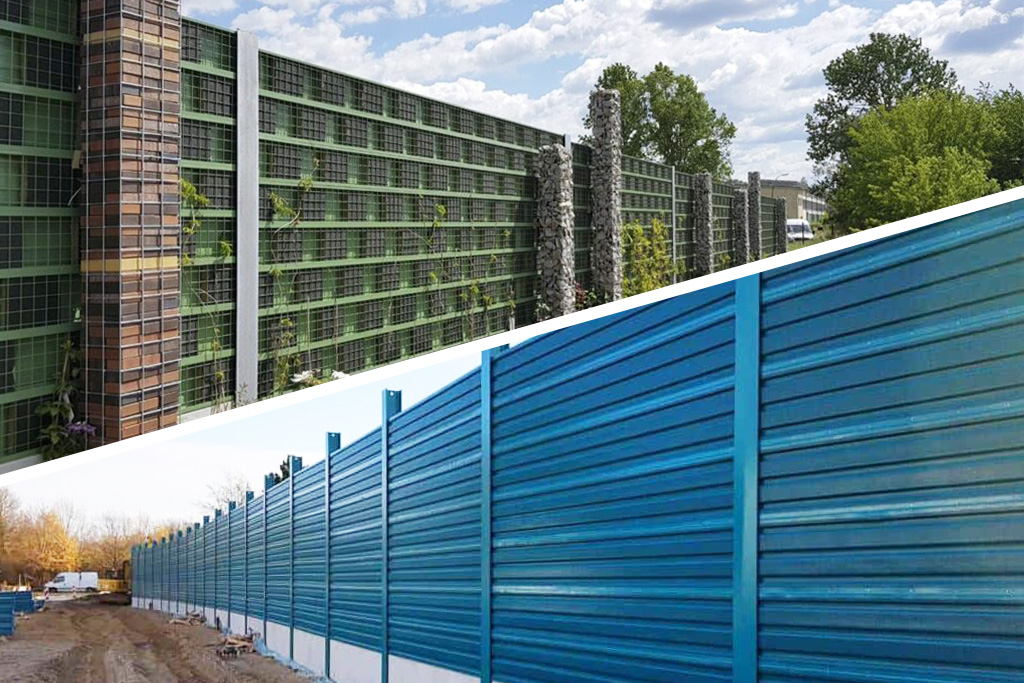
Due to rising noise levels, especially in conurbations, it is hard to imagine rural and urban areas without noise protection systems. They ensure that people can enjoy peace and quiet and relaxed leisure time in areas worthy of protection, such as residential areas.
In the following blog article, you will find out what a highly absorbent noise barrier is, what exactly reflective noise protection means and what the differences, advantages and areas of application are. With many years of experience and expertise, RAU® is at your side when it comes to sustainable noise protection.
When exactly is a noise barrier (highly) absorbent?
In accordance with DIN EN 1793-1, the term “highly absorbent” basically covers all noise barriers that can demonstrate sound absorption of more than 8 decibels (DLa, NRD > 8dB). The sound is either converted into thermal energy or dissipated within the noise barrier. Porous materials such as rock wool, porous concrete or our hemp fiber Canwool are used for this purpose, as they are ideally suited for sound absorption. The materials are characterized on the one hand by their rough surface and on the other hand by an open surface area in their construction to disperse the sound. Highly absorbent sound insulation systems reduce sound reflection by more than 5 decibels (dB) on average. In principle, however, absorption and insulation depend on the acoustic properties of the materials used.
Highly absorbent noise barriers are particularly useful for projects that aim to minimize high levels of noise, for example at airports or in rail transport.
Which sound insulation is reflective? Where is it used?
Reflective noise protection is primarily used for effective noise reduction in residential areas. Like a mirror, these noise barriers reflect the resulting noise, for example from industry or adjacent leisure facilities, directly back onto the source. This protects areas behind the wall from excessive noise levels. Reflective walls are usually made of materials such as metal, concrete or glass, as these have very good properties when it comes to reflecting sound waves.
The difference between reflective and highly absorbent noise barriers
Similar to active and passive noise protection, a highly absorbent noise barrier differs from a reflective noise barrier in terms of its functionality. The names say it all: while the former absorbs the noise, so to speak, the latter reflects it back to the source. Due to the different advantages that result from this, the two types of sound insulation are used in different situations. However, a combination of highly absorbent and reflective sound insulation is often useful, as this ensures particularly comprehensive noise insulation. For example, the highly absorbent side of the noise protection element can be used on the side of the emission point to reduce reflections, while the reflective side of the system is used in front of the immission area. In this way, the sound level is reduced in two ways in the long term and in the best possible way.
Noise protection systems from RAU®: highly absorbent or reflective
RAU® is your specialist for both reflective and highly absorbent noise protection measures in public transportation, on roads and freeways and many other locations. We offer various solutions for noise insulation, including noise remediation, but of course also our high-quality, ecological and climate-neutral noise barriers. Our products effectively shield adjacent immission areas and thus demonstrably improve the quality of life of local residents. At the same time, our noise protection systems are designed to be visually appealing.
At RAU® you will find both highly absorbent noise barriers and reflective noise protection.
Product
Functionality or type of noise protection
absorbent / highly absorbent
absorbent / highly absorbent
absorbent
absorbent / highly absorbent
reflective (one-sided) / highly absorbent
Gambion columns (with RAU® NoiseGuardGreen)
absorbent
Reflective sound insulation from RAU®
Highly absorbent noise barriers from RAU®
At RAU®, we specialize in the development, planning and construction of absorbent noise protection. Our range therefore includes a variety of products that effectively reduce noise levels.
The RAU® Climatewall S and RAU® Photovoltaic are examples of this. The noise barrier made of stone impresses with its minimal space requirement and effortless greening, while the noise barrier with solar cells offers you the first solar noise protection solution in Germany.
The highlight, however, is our RAU® Climatewall. This not only minimizes noise levels in the surrounding area, but also CO₂ emissions! The combination of climate-friendly production and construction as well as permanent greening to compensate for habitats for small animals makes it the most ecological noise barrier from RAU®.