


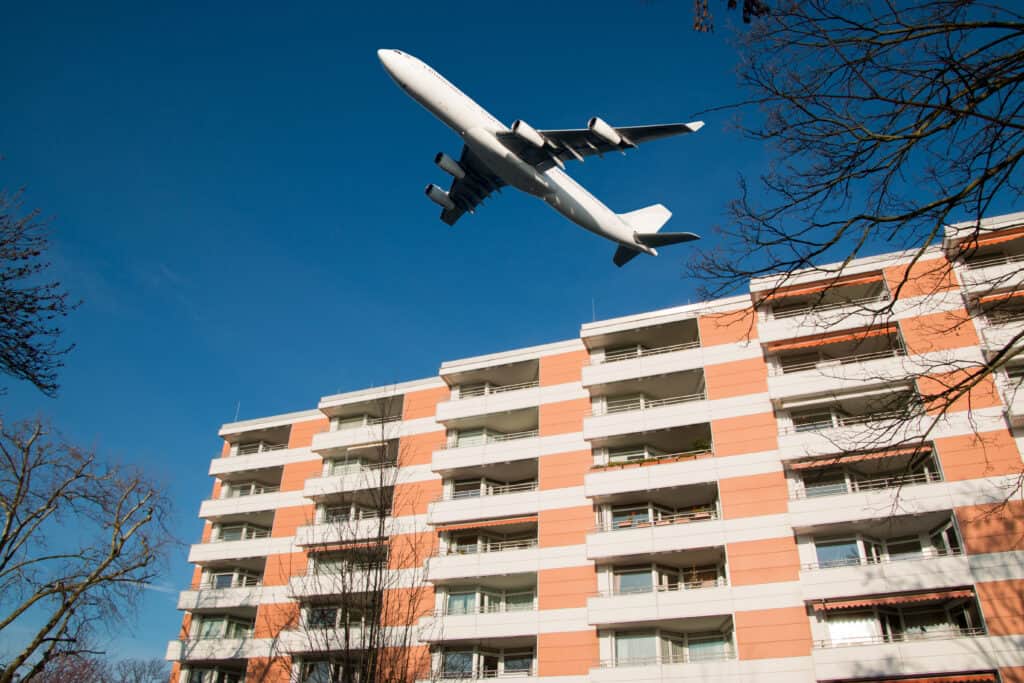
Many people probably associate the gentle hum of an airplane flying by in the sky with freedom, travel, relaxation or simply switching off from everyday life. However, the sound of an airplane is not a reminder of the last vacation for everyone. Around 37 percent of Germans find aircraft noise annoying on a daily basis and feel disturbed by it. Aircraft noise is particularly strong at short distances from homes and commercial premises to airports. After all, an aircraft generates decibels (dB) of between 110 and 140, mainly caused by take-offs and landings during the day or test runs at night.
We explain how noise protection in relation to aircraft can be possible. We also show you how noise protection around airports can be guaranteed for neighboring residential buildings.
Is aircraft noise a problem?
Restful sleep is becoming increasingly important, especially now in our overstimulated society. But night-time aircraft noise prevents many people from doing so. Targeted noise barriers with sustainable materials and green design can greatly reduce emission levels. The German government has already passed the “Act on Protection against Aircraft Noise”, thus creating opportunities for those affected to ensure structural noise protection to protect the general public and the neighborhood, among other things. The Aircraft Noise Protection Act also stipulates how high the maximum decibel value (dB) may be for aircraft in protection zones. The maximum level caused by aircraft noise at night is between 50 – 57 dB. In comparison, the decibel value of an aircraft take-off is 140 dB. Aircraft noise at night is therefore effectively restricted by this law.
How does aircraft noise affect health?
A representative study conducted by the Federal Environment Agency in 2010 showed that night-time aircraft noise impairs well-being, reduces quality of life and can even make people ill. Health problems of the heart, the circulatory system and even mental illnesses were identified and investigated in people exposed to high continuous noise levels. This study alone shows the enormous impact of aircraft noise and the importance of noise protection at airports.
Noise protection at the airport: what are the benefits of night flight bans?
As with noise protection on roads and railways, noise emissions at night at airports have already been significantly reduced, as even low levels of aircraft noise can be exhausting and even harmful in the long term. The night-time quiet period from midnight to 5 a.m. is therefore intended to provide noise relief and promises a quiet night for all residents. However, exceptions for aircraft take-offs and landings also apply here under certain conditions. It should also be emphasized that “restful sleep” is not necessarily achieved with 5 hours of rest. In the off-peak hours from 10 p.m. to midnight and 5 a.m. to 6 a.m., noise from aircraft is only permitted to a limited extent, but any aircraft is a significant noise nuisance if you live close to the runway.
How can aircraft noise be reduced through active noise abatement?
A general distinction is made between active and passive noise protection measures when it comes to noise reduction. Passive noise protection refers to the shielding of noise through sound insulation or refurbishment of buildings or other structural measures. Noise reduction through active noise protection takes place directly at the source of the noise. In this case, for example, this means direct adaptation to the aircraft. However, noise barriers also count as active noise abatement, as they are specifically used to provide demonstrable protection for emission points, i.e. noise protection areas. For this purpose, they are erected at the source of emissions, in this case around an airport. Concrete noise barriers are well-known and extremely common, as they are particularly durable and easy to maintain. But why not build effectively and sustainably for the future? RAU® makes exactly that possible. Green noise barriers not only create a visual highlight, but also compensate for the high pollutant emissions from aircraft. Over the years, the Climatewall binds more than 100 times the production emissions and at the same time offers sound insulation of 68 dB and sound absorption of 20 dB.
Noise barriers from RAU® are the optimal measure against aircraft noise & more
If you opt for noise barriers from RAU®, you are actively deciding against aircraft noise. Our range offers you numerous sustainable solutions for your requirements. Manufactured to the “made in Germany” standard, RAU® noise barriers promise the highest quality and long-lasting protection. RAU® is the leading noise barrier manufacturer in Germany, using only sustainable materials and conserving resources without exception. Say “No” to aircraft noise and “Yes” to sustainable sound insulation with RAU®. Our expertise will convince you.