


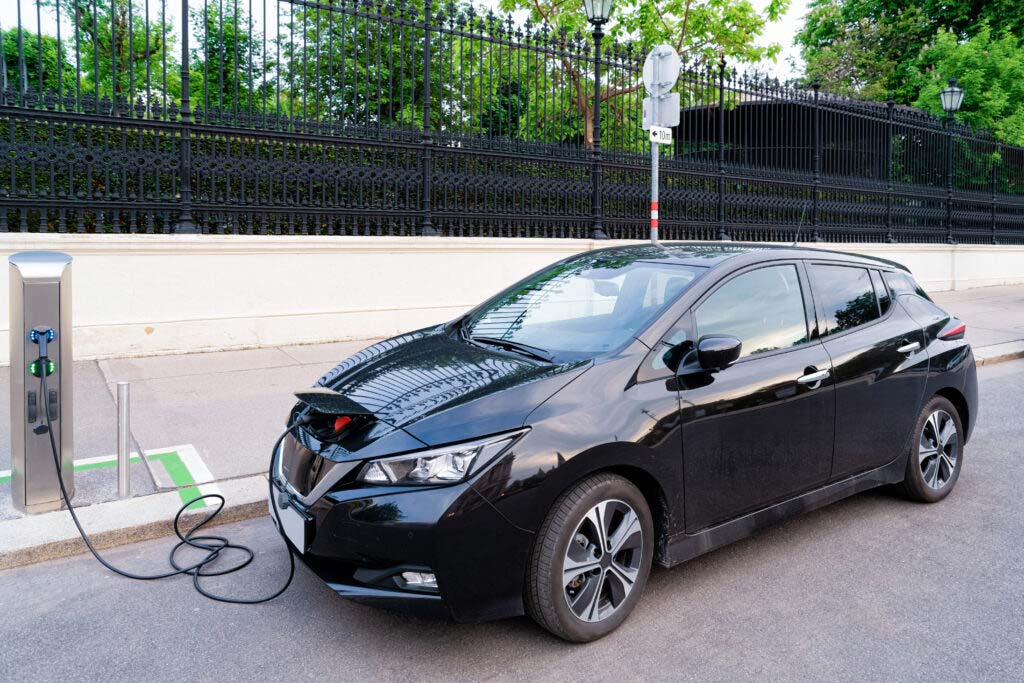
Many people are deciding to switch to an electric car, or e-car for short. In times of rising petrol prices, an electric car seems to be the more economical option – and environmentally friendly too. Another advantage of an electric car is the seemingly low noise pollution compared to combustion engines. With regard to noise barriers, the question arises as to whether noise protection is still needed? We answer this question for you.
Enormous noise pollution from road traffic
Noise pollution from road traffic is a polarizing issue, as noise can have a long-term negative impact on people’s health. Noise barriers are therefore essential for road traffic. According to the Federal Environment Agency, road traffic causes the greatest noise pollution in everyday life, with over half of all citizens in Germany feeling disturbed by noise pollution from road traffic. Particularly at night, long-term disturbance from road noise can have a negative impact on mental and social well-being. Noise pollution should therefore not exceed a level of 65 dB(A) during the day and 55 dB(A) at night. dB(A) is the unit of measurement of the sound pressure level, or noise level, according to the internationally standardized frequency weighting curve A. The value depends on the distance from the sound source. Road traffic noise is made up of various factors, and combustion engines are one of them. This is one of the reasons why the German Road Traffic Act (StVO) prohibits the unnecessary running of vehicle engines, unnecessary driving in built-up areas and unnecessary acceleration. Read more about the relevance of noise protection here.
Health consequences of noise pollution
Sounds are sound waves that become noise when they are perceived as disturbances, nuisances, impairments or damage. Important: Sounds, or noise, are also registered during sleep. It is therefore a misconception that you can get used to noise.
High levels of noise pollution can lead to hearing damage. However, even low levels of noise pollution, for example traffic noise from combustion engines, electric cars or public transport, can trigger physical stress reactions. The consequences are
Changes in blood pressure, heart rate and other circulatory factors
Release of stress hormones that affect metabolic processes
The fact is: noise can make you ill and you should be protected from it.


Reduce noise with noise barriers
Consequently, noise barriers certainly have their raison d’être. After all, noise barriers are a good way of reducing road traffic noise on busy roads. Noise barriers ensure a better quality of life and contribute to general well-being. But will noise barriers still be needed if the proportion of electric cars on the roads continues to increase? For the time being, the answer to this question is a simple “yes”. To delve deeper into the topic, the following questions need to be answered: What is the noise pollution level of the various e-car models and what is the distribution of electric cars in city centers?
Types of electric cars: How high is the noise pollution?
In order to be able to say more about electric car noise, the different electric car models should be discussed. There are five different models:
1. battery electric vehicle (BEV)
Battery electric vehicles that are equipped exclusively with a purely electronic motor and draw their energy from a battery.
2. battery electric vehicles with range extender (BEV-REx)
This model has a small combustion engine to recharge the electronic battery.
3. hybrid electric vehicle (HEV)
These are hybrid vehicles whose electronic battery is charged by the combustion engine. The electronic drive is taken over as soon as the battery is fully charged.
4. plug-in hybrid electric vehicle (PHEV)
It is also a hybrid vehicle with two motors. However, the electric motor is charged externally and the range is also greater thanks to the larger battery.
5. fuel cell electric vehicle (FCEV)
A fuel cell vehicle that generates its electrical energy from hydrogen and oxygen while driving. The energy is converted into motion and stored in a battery.
How much noise an electric car generates therefore depends on the type of drive. A BEV runs very quietly, while a hybrid vehicle combines the advantages and disadvantages of combustion engines and electronic motors in terms of noise pollution. This means that hybrids often use the electric drive at low speeds and are therefore very quiet. As soon as the hybrid vehicle switches to combustion engine mode, the noise pollution is the same as with “normal” cars. However, one advantage of hybrid vehicles is that short-term noise peaks, such as the roar of the engine or starting off, are reduced.
E-cars: noise or quiet alternative
Electric cars have experienced a real boom in recent years. In 2022, 827,321 hybrid-powered cars were newly registered. This corresponds to a share of 31.2 percent. Of these, a total of 470,559 battery electric vehicles (BEV) were registered, which corresponds to a share of 17.7 percent according to the Federal Motor Transport Authority. In order to noticeably minimize noise pollution from road traffic, the proportion of purely electric vehicles would have to be over 30 percent. This applies to inner-city traffic at low speeds. This is because studies have found that the noise emission of electric cars at low speeds, between 25 and 50 km/h, is significantly lower than that of combustion engines. As soon as this speed is exceeded, there is no noticeable or audible difference.
The advantages of an electric car in terms of noise pollution are as follows:
E-cars are impressive when stationary, when the engine is running. While combustion engines can be heard when stationary, for example at traffic lights, nothing can be heard from electronic vehicles.
When driving at low speeds, electric vehicles are also superior to combustion engines. Up to a speed of around 20 km/h to 25 km/h, the rolling noise of electric cars is barely perceptible.
An electric drive makes sense for large vehicles such as buses, clearing vehicles and refuse collection vehicles. This is because the difference in noise is clearly audible compared to normal cars.
In city centers with high stop-and-go traffic, electronic vehicles make sense because the noise level generated by starting and braking is reduced.
Noise protection and electric cars: Is noise protection still necessary?
The noise emissions of electric cars are very low. Electric cars do not make a significant contribution to reducing road traffic noise in city centers, even if the proportion of electric cars is steadily increasing. Noise levels on freeways are still very high, so noise barriers are indispensable.
The paradox is that at low speeds (under 20 km/h), electric cars are noticed too late or not at all by pedestrians, often also by older pedestrians. This is why, since July 2021, it has been a legal requirement for electric cars to be equipped with an AVA system (Acoustic Vehicle Alerting System). This generates artificial engine noise and therefore continues to cause noise in city centers.
Green noise barriers from RAU®
In combination with electronic cars, the green noise barriers from RAU® are a good way of counteracting the environmental impact of combustion engines. Green noise barriers such as the RAU® Climatewall insulate noise and offer protection for people and animals. They are urgently needed despite the increase in e-cars, as the proportion of electronic vehicles in road traffic is currently still too low to make an audible difference. The AVA system also means that electronic cars are not completely quiet. As soon as the speed increases, for example on expressways and main roads, the noise level of electric cars is also clearly audible. Noise barriers are therefore indispensable.